Last updated on December 1, 2021

If English is not your first language, you will struggle with some words. Like brussels sprouts. You hear all the time, “I hate brussels sprouts,” and you start to wonder what the poor guy did. Everybody talks about him, he must be a celebrity.
Then you find out it’s not a person, but the name of a vegetable, because some vegetable seem to need two names -a first name, and a family name. Welcome to the English language, a new kind of hell everybody enters who wasn’t raised with this beautiful language.
I speak a few languages, even managed to learn Latin and Old Greek in school, and while both languages are complicated -and hard to learn- they don’t even come close to the English language.
English, full of Homophones (words that sound the same but are different in meaning or spelling) Homographs (words spelled the same, but differ in meaning or pronunciation), and Homonyms (can be either or both.) That’s not just hell, that’s a BLOODY HELL

A simple sentence:
She told him that she loved him.
Now take the word ‘only’ and put it anywhere in the sentence! Voila, does it make sense? Nope, not the slightest but it works! It’s hell!
English is downright weird, yet it can be understood through tough thorough thoughts, though. It’s a special kind of hell.
Let me show you what I mean:
Two students, James and John were given a grammar test by their teacher. The question was, “Is it better to use ‘had’ or ‘had had’ in this example sentence?”
The teacher collected the tests and looked over their answers.
James, while John had had ‘had’, had had ‘had had.’ ‘Had had’ had had a better effect on the teacher.
It’s a new kind of hell.
And the logic behind it, don’t get me started:
Take the word Australia, it brings foreigners to their knees. Three A’s and all are pronounced differently.
And then there are rules you can’t find in a grammar book, and native English speakers aren’t even aware of the rule, but use it all the time -correctly if I may add.
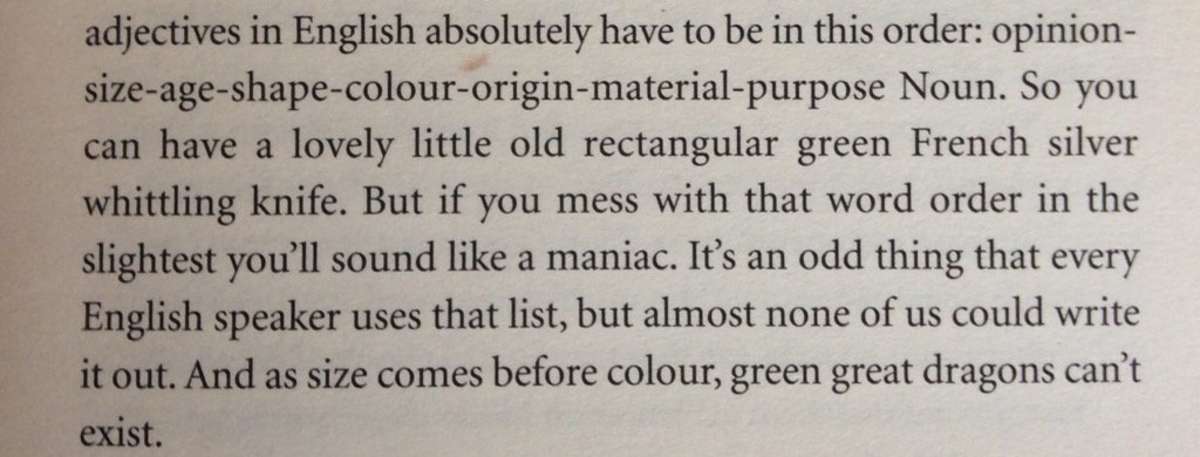
Don’t even try to mess with this order, or you will look like a complete moron. THEY -meaning the English and the British English, and the Australians, and the English Canadians follow this stupid rule, without knowing. It’s not normal if you ask me!
I triple dare you to ask a native English speaker about the adjectives order. Go, make a fool out of yourself.

Who comes up with stuff like that?
There are words like defenestration and overmorrow. Nope, I am not making this up!

Defenestration! Let me think. How often have I used this word so far? ZERO! Chances I ever use it? ZERO! Defenestration, right from the start?
Now, so many years later, I can make fun of it and understand most of it, some only by the use of the phrases and the words, because there just isn’t a logical explanation you could give an intelligent human being.

I will never forget the evening so many years ago, when we went out for dinner with a couple and their mom. I had just become brave enough to speak in complete childlike English sentences. “I have recently lost my husband,” the old lady who was sitting next to me said, and I didn’t respond right away. I tried to sort things out in my head. What did she just say?
“So, you don’t know where he is?” I asked her in disbelieve and everybody looked at me at me.
“She said she can’t find him,” I insisted, which was instantly corrected. “She has lost her husband, it’s not that she cannot find him.”
(Thinking pause on my end)
“You mean she knows where she lost him?”
It was a fun evening, and my confusion even made the older lady smile.
As many of you know, I was (or am) a translator and interpreter. Guess what language I didn’t work with? Correct!
Do you want to know when I knew I would not mess with English? When I read this:
I’dn’t’ve!
Y’all’d’ve known!
So to answer a question nobody dares asking (axing) me. Will I ever be fluent in English?
I object to this object!

The vagaries of English … yet most of us use only a smattering of the words available to us.
Because if we use too many we turn people off, or come across as arrogant, or the majority doesn’t understand us anymore.
I always wanted to learn Mandarin, or at least Cantonese. It seems to me that East Asian languages, along with their fascinating ‘character’ alphabets, are about as far from English as one could try learning, which interests me. Some years ago, I took a beginners 10-week course in Mandarin (i.e. a two-hour class every Wednesday), during which I mastered a Mandarin tongue twister, albeit without the properly designated tones (that would be too much for me to remember).
English is a horrible language to try to learn. It is my first language and I often wonder how I managed to learn it. You should be commended for making it work for you.
So gratified to see I’m not the first or only one to realize that French drops half the word in pronunciation. I didn’t realize the bit about Spanish tenses but then I really never had to use it everyday speech. Finally, I’m so glad I passed on German with those really long words, even if they may be truly accurate and descriptive by the time you get to the end if you remember them all.
The way we have stolen words in English makes me think it’s not that different than our economic system!
German is an interesting language, so is French or Italian. As for English…nope thank you. 🙂
Wonderful post! I was born English speaking, but bumped into Spanish and German at an early age and was immersed in French (Belgian) sufficiently young to reach fluency (not necessarily accuracy). I later leaned a little latin and more Italian. All of these languages had patterns, rules, grammars and pronunciations that made sense and a manageable number of exceptions in all these areas – whereas English! … we borrowed from so many other languages, absorbed much from so many peoples who came/saw/conquered us that English is really not ‘one’ language. I was always baffled as a child that so many in the world chose it instead of the many beautiful alternatives. And yes, you are right, I had absolutely no idea about the set adjectival order!
It’s the adjectival order fascinating? It floored me. My friend, you chose some hard languages to learn as well. Good for you.
I am so glad you liked this post.
Maybe I should stop being so hard on myself for my illiteracy in any language other than English! I admire people who can speak and understand multiple languages, Bridget, and other than a smattering (small, small smattering) of French and Spanish, I’m not at all capable of communicating properly in a non-English speaking country. But, since, as you accurately describe the complexities of the English language, perhaps I’m more skilled than I thought! LOL! Seriously, the majority of my neighbors here in Los Angeles County are immigrants and some really do struggle with English. I always feel badly for their ongoing struggle!
You have a wonderful way of wording what you want to say. I noticed this about you right away. So many try so hard (too hard, too often) but you seem to be a natural gifted writer.
I lived in Los Angeles for four years, that’s where we started out. The Latino’s there have a hard time because they get spoiled hearing their native language everywhere. They aren’t forced to learn (quickly) as I was. Their struggles with learning to be fluently are homemade. 🙂
I think that it is illegal to use the term sick to mean very good if you are over the age of 19!
Bridget, you’re a gem, and by that I do not mean that you are an opal, or a ruby, but you are a diamond! This post is sick!
I take ‘This post is sick’ as a compliment? 😍
(Me, likes being a diamond.)
Now I am doubting my ability with words – cos you’re doin’ my ‘ed in, innit.
Did you defenestrate your confidence?
(Innit =that’s one of the British tortures to foreigners.)
🙂
Brilliant post! I love the word pineapple because in loads of other languages it’s ananas, yet we have to be different! But likewise, in Dutch the word for potato is aardappel = Earth apple. These apples crop up all over the place!
Same in German and in Austria, Erdapfel. In France ‘Pomme de Terre’ it makes so much sense, doesn’t it?
Thank you for stopping by and commenting.