
The Cemetery of the Nameless is not easy to find. Only a few signs along the way point to this place only thirty minutes from downtown Vienna, the Capital of Austria.
This cemetery is the only burial ground in the world reserved exclusively for the nameless victims of the river (Nameless= Namenlos in German as you can see written on the sign.) Until 1940, murdered people, accident victims, and victims of unsolved criminal cases found their final resting place here, all of these mostly unknown dead, who were washed up and buried immediately.
Simple wrought iron crosses are the only witnesses and reminders of the victims of the river. Sometimes there is a sign on the crosses, and usually written by hand you can read “Nameless”, “Unknown”, “Male”, “Female” and perhaps a date on which the body was washed ashore. Only a few graves have any indication of how these people died.
The cemetery of the Nameless is a spooky place. It is said the nameless can be seen wandering around at night and I thought it sounded reasonable enough to not visit the place.
The Cemetery of the Nameless consists of two parts. The older area of the cemetery is hardly visible today. Trees and shrubs have overgrown the burial grounds. Again and again, this part of the cemetery was flooded, it is too close to the river Danube, the long river that passes ten countries on its way from the Black Forest in Germany to the Black Sea in Ukraine and Romania.
…

…
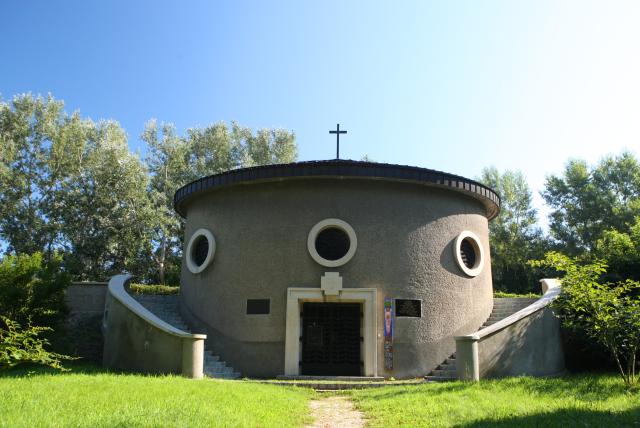
In 1900 a newer part of the cemetery was built on the other side of a new protective dam. In 1935 a stone enclosure wall and the Chapel of the Resurrection was built. In the new part of The Cemetery of the Nameless, a total of 104 water bodies were buried between 1900 and 1940. Only 43 of them could be identified.
In 1939, a new harbor in Vienna was built and the conditions in the Danube River changed. Since then, hardly any corpses have washed up at this site and if they do, the dead were buried in Vienna’s Central Cemetery -one of the largest cemeteries in the world.
According to official sources, the last burial in The Cemetery of the Nameless took place in 1940. The cemetery is now part of the port.
Gravedigger Josef Fuchs
…

…
A volunteer gravedigger, Josef Fuchs, is inseparably linked to the history and preservation of the cemetery. He looked after the cemetery with great care and buried the nameless of the water until 1939. Josef continued to take care of the graves even after his retirement until he died in the spring of 1996 at the age of 90.
Josef also made sure that, contrary to the name of the cemetery, many of the dead did not remain completely nameless. When a corpse was fished out of the Danube, Josef Fuchs began to investigate. Of all the corpses he buried himself, Fuchs was able to identify all but one.
The victims of the Danube and the dead in The Cemetery of the Nameless are remembered every year. On the afternoon of the first Sunday after All Saints’ Day, the members of the Albern Fishermen’s Association gather to launch a raft they have built, decorated with wreaths, flowers, and lit candles.
On the raft there is a symbolic tombstone with the inscription “To the victims of the Danube” and the request, written in German, Czech, and Hungarian, that if the raft gets stuck on the shore, simply push it back into the water.
…

…
The procession then walks to the banks of the river Danube, accompanied by a band. With a wooden barge, the fishermen bring the raft to the middle of the stream to hand it over to the floods in memory of the anonymous victims of the Danube River. Some of these rafts are said to have drifted very far until they finally disappeared.
I lived in Vienna the capital of Austria for three years, during that time I did a lot of walking and explored the city from south to north, from east to west. I walked by The Cemetery of the Nameless numerous times but never entered.
…

…
Years later, when I lived in the US I made the story of Josef Fuchs, the volunteer gravedigger, the subject of an essay, as part of my translater exam.
Actually, now almost forty years later, I should share his story here on my blog as well. What a remarkable man he was.
Would I ever visit The Cemetery of the Nameless?
No, I still would only walk by and pay respect from the outside.


What a fascinating place
The story and the background is fascinating. Now being older I might be brave enough to go in. 🙂
Hi , how are you
Although I am Viennese, I have never been to this cemetery. Thank you for your contribution, now I will finally go there.
Interesting answer to the prompt. It is sad that so many are buried without identities. I am kind of on the fence about the idea of ghosts, but if there was a reason to still walk the land, being buried without recognition would be one. I look forward to learning more about Josef and his efforts to identify the victims of the river.
Interesting place. The Danube is not a river to mess with. I am always somewhat in awe when I see it. When I was young, I used to fish a lot, and local Dutch fishing magazines often published travel reports on the river monsters of the Danube. Ever since, I look at that river with a different view. As a child, it seemed an exotic and far away place. Now it’s probably 30 km away.
Clearly an important project which would be more spooky than any other cemetery
It’s gratifying to know these souls were given a final restig place and are still remembered. Josef Fuchs was a good and caring man. Thanks for sharing his story, Bridget. 🙂
How sad to have unclaimed and nameless people. I don’t think I’d want to visit either, Bridget.
I think every city has them. The graves for the nameless, the homeless, the outcasts. Here in the US it’s called Potter’s field.
I’m not aware that we have one here, Bridget. I’ll have to check.
Fascinating
I enjoyed this very much Bridget and look forward to hearing more of Josef, the ordinary man who did extraordinary things.
This place sounds spooky but fascinating. I do hope you post your story about the gravedigger.
I will. I already put an empty post with his name in my draft (this way I can’t forget.)
Great idea!
That was so interesting. It’s people like Josef that are the heroes… such care and respect for the lost buried there.
I agree with you. The biggest heroes are the quiet ones who work quietly all their lives without asking for attention or rewards.
Thanx for a great read. I have always been fascinated with cemeteries and have visited many in my travels, I would love to see this one as what you wrote about it is very interesting. Have a great day
Ernie, then you have travel to Europe and visit Austria. Cemetery-wise you will be in for a treat 🙂
Very interesting!
An amazing story for sure. So glad they built the new harbour. It does indeed look like a spooky place. Happy Tuesday. Allan
The history of the cemetery is fascinating, so is Josef Fuchs’s story. Thank you for reading. Have a great day.
Thank you for sharing this. I learnt a lot today. All which is new to me. Important history I feel.
That’s dedication that Josef did for those people buried there. A very caring man and an inspiration looking after the burial sites.
I appreciate you taking your time reading about the Nameless Cemetery and Josef’s story. There are so many places in this world that deserve to be known, yet most of them stay hidden. I am glad I found and ‘excuse’ to write about it.
What a fascinating story, Bridget. God bless those who remember the dead.
Thank you for stopping by, Mary. Remembering the nameless dead every year is such a wonderful ritual.
I’m intrigued although, it does sound spooky! 🩷🌷
It is very intriguing, I thought so too. Thank you so much for reading, Kymber.