
Days later it struck me that I had watched a man die when I saw George Flyod’s begging for air. The video showed George Floyd, the man, at his most vulnerable moment and I witnessed it -unable to help, unable to change the outcome.
Days later it struck me that I had watched a man die when I saw George Flyod’s begging for air. The video showed George Floyd, the man, at his most vulnerable moment and I witnessed it -unable to help, unable to change the outcome.

My blogging friend Lisa, who I call “The Birdlady” as a form of endearment, posted this beautiful piece on her blog A DAY IN A LIFE. The following text resonated not just with me, but with many of my friends who I forwarded it to. I don’t like the reblog function, so with Lisa’s permission, I repost this here on my blog.

Stay home, they say and I do.
Don’t stress out, they say and I try.
We are in it together, they say
and I know they are lying.

Brother Richard Hendrick, a Capuchin Franciscan living in Ireland, has written a touching poem about our uncertain times living with the coronavirus.
Yes there is fear.
Yes there is isolation.
Yes there is panic buying.
Yes there is sickness.
Yes there is even death.

If luck you chase, you have not grown
enough for happiness to stay,
not even if you get your way.

There should be nothing here I don’t remember . . .
The Gulf Motel with mermaid lampposts
and ship’s wheel in the lobby should still be
rising out of the sand like a cake decoration.
My brother and I should still be pretending
we don’t know our parents, embarrassing us
as they roll the luggage cart past the front desk
loaded with our scruffy suitcases, two-dozen
loaves of Cuban bread, brown bags bulging
with enough mangos to last the entire week,
Wilhelm Busch confessed later on in life, that some things in his book really did happen. His friendship with the miller’s son Erich Bachmann and their childhood antics together likely inspired the figures of Max and Moritz. A pencil portrait that Bush drew at age 14 shows Bachmann as a young man with thick, round cheeks like those of Max.
Regardless of how one interprets the story of Max and Moritz, the famous picture book is actually considered to be the pioneer of modern comics.
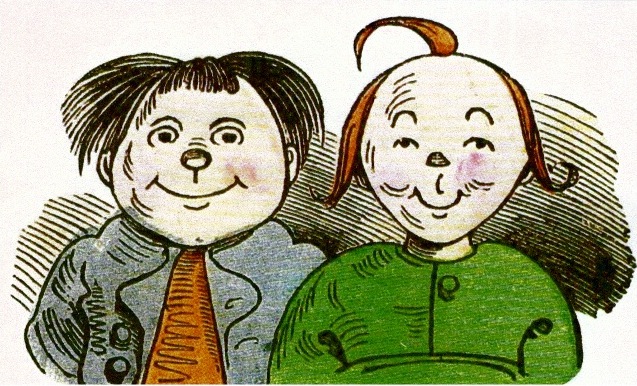
Max und Moritz was initially rejected for publication, it was never meant to be a children’s book. It was Busch’s publisher Kaspar Braun who suggested offering it through the children’s book division of his publishing house rather than in the pages of the satirical weekly, Fliegende Blätter, as Busch had suggested. Braun paid Busch 1000 guilders, the equivalent of about 2 years’ pay for a craftsman, for the rights to his manuscript.

Children’s books first appeared in the later 18th century and were strongly moralizing and educational. The books were meant to teach and instruct, not to entertain, and the child figures in those books behaved like miniature adults.